Fes! Cultura joins the FIL_IN showcase at Fabra i Coats

An afternoon of afro-soul, Caribbean rhythms, and sounds from the Colombian Pacific as part of the Fabra i Coats resident music showcase.

The FIL_IN showcase opens from March 5 to April 18 at Fabra i Coats: Creation Factory, a cycle that brings to the stage the creative processes of the space’s resident musical projects. In total, 21 acts will share their work with the public in a concert format that echoes the venue’s past as a former textile factory.

Over several weeks, the multipurpose halls of Fabra will be filled with music, presenting projects that are currently taking shape in a living moment of their creative process.

Within this framework, Fes! Cultura (Connectats Cooperativa) – a cultural incubator supporting projects led by migrant artists and a resident project at Fabra i Coats – joins the programme on Saturday, April 11 at 7:00 pm with a session featuring three powerful and diverse musical proposals.

Tina Masawi

The afternoon will begin with Tina Masawi, a Zimbabwean-born singer presenting her debut album with a powerful and elegant afro-soul sound.

Her music blends pop, R&B, blues, and afrobeat, creating a sound that connects with her roots while showcasing great stage versatility. Her work has already resonated at festivals such as Cruïlla and Jazztrònica, establishing her as one of the most exciting emerging voices in Barcelona’s music scene.

Cecé & The Soul Kitchen

From Venezuela comes Cecé & The Soul Kitchen, a project that explores an urban universe where soul, jazz, hip-hop, and R&B coexist with Caribbean rhythms.

Led by artist and producer Cecé, the group builds bridges between the Latin American diaspora and Barcelona’s contemporary music scene, in a proposal where tradition and urban spirit naturally come together.

La Ruka

The evening will culminate with La Ruka, an explosive proposal that blends hip-hop, dancehall, electronic music, salsa, and sounds from the Colombian Pacific.

Based in Barcelona, the artist explores cultural resistance through direct lyrics and a powerful sonic energy that celebrates identity, memory, and Afro-descendant roots.

This collaboration between Fabra i Coats: Creation Factory and Fes! Cultura stems from the desire to expand the city’s cultural circuits and open space for musical proposals led by migrant and racialised artists living and creating in Barcelona.

Fes! Cultura, a programme promoted by Connectats Cooperativa, supports cultural projects by artists from diverse backgrounds and facilitates their development within the cultural ecosystem of Catalonia and Spain.

Listen to the FIL_IN mixtape

Practical information

Date: 11 d’abril de 2026
Time: 19.00 h
Location: Fabra i Coats: Fàbrica de Creació
Carrer de Sant Adrià, 20 · Barcelona

Free entry

Graphic design: La Murga Lab

Laboratory 2026


REGISTRATION FORM

What is Fes! Cultura

Fes! Cultura is a platform that promotes cultural diversity by training, supporting, and fostering cultural projects with social impact. We work from the conviction that culture is a key space for self-organisation, the contestation of imaginaries, and the activation of urgent conversations around migration, anti-racism, cultural rights, and social and environmental justice.

We are a community of creators, artists, cultural mediators, students, and professionals who are committed to collective processes of learning, creation, and production, placing at the centre the voices and experiences of migrant and racialised people in Spain.

Fes! Cultura structures its work through different lines of action: the incubation of cultural projects; the dissemination and promotion of artists and projects through communication actions and original content; the production and presentation of cultural proposals in different formats and contexts; and social advocacy, generating positions, debates, and frameworks of thought from an anti-racist and rights-based perspective.

Cultural Projects and Enterprises Laboratory

This year, we present a modular training programme aimed at empowering artists and cultural agents from diverse backgrounds, with the goal of strengthening their professional skills, facilitating their integration into the local cultural ecosystem, and promoting sustainable models of cultural development.

The programme provides practical tools to design, fund, and manage cultural projects with impact. It combines cultural rights approaches with strategies for economic sustainability, visibility, and professionalisation, in order to strengthen the role of migrant and racialised cultural agents as key actors within Catalonia’s cultural landscape.

Who is it for?

Fes! Cultura #MigrantAction is aimed at artists and cultural management professionals from diverse backgrounds living in Catalonia who are developing a project in the field of arts, creation, or culture. Priority will be given to proposals with growth potential related to performing arts, visual arts, music, audiovisual practices, literature, or digital culture.

How do we do it?

  • Total duration: 10 sessions / 32 hours
  • Dates: April 7 – June 9, 2026
  • Schedule: Tuesdays, 10:00 am – 1:00 pm (April 28 and May 5: 10:00 am – 2:00 pm)
  • Location: Centre d’Arts Santa Mònica i Fabra i Coats: Fàbrica de creació
  • Frequency: 1 session per week
  • Format: in-person
  • Methodology: lectures combined with practical and participatory exercises

Programme

  • Session 1. Introduction and initial project pitch

Welcome, presentation of the programme, and initial pitch of the selected projects.

  • Session 2. Designing cultural projects with impact (Part 1)

Introduction to the core skills needed to conceptualise a cultural project with impact. We work on diagnosis, strategic approach, and alignment with cultural rights to structure viable and relevant proposals.

  • Session 3. Designing cultural projects with impact (Part 2)

In-depth work on the technical structuring of the project: defining objectives, planning activities, allocating resources, scheduling, and designing evaluation and sustainability strategies.

  • Session 4. Public funding and cultural calls

Overview of grants and public funding at local, regional, and national levels. Practical analysis of real calls and evaluation criteria.

  • Session 5. Direct funding and sustainable income models

Exploration of self-generated funding: ticket sales, services, collaborations, patronage, and digital monetisation. Development of hybrid models.

  • Session 6. Evaluation and sustainability of cultural projects

Definition of indicators and methodologies to measure impact. Reflection on alliances, care practices, and medium-term continuity strategies.

  • Session 7. Communication for cultural projects

Exploring how strategic communication can support the growth of your project and your community.

  • Session 8. Legal structures and organisational models

Comparative overview of legal frameworks: freelancers, associations, cooperatives, and limited companies (SL). Practical cases and legal support resources.

  • Session 9. Taxation and invoicing for cultural agents

Practical guide to invoicing legally and managing basic taxes (VAT, income tax).

  • Session 10. Closing session and project presentations

Space to share projects, acknowledge collective work, and project future pathways. Certificate delivery and final celebration.

Practical information

Applications: fill in this form.

Open call until March 5, 2026 (inclusive)

Places are limited, and selection will be based on criteria of diversity of origin, gender, and strength of the proposal. This is a funded programme, free of charge for participants.

When and where?

April 7 – June 9, 2026

Tuesdays, 10:00 am – 1:00 pm (April 28 and May 5: 10:00 am – 2:00 pm)

Fàbrica de Creació Fabra i Coats. c/ Sant Adrià, 20. Barcelona.

<M> Sant Andreu

Centre d’Arts Santa Mònica. La Rambla, 7. Barcelona.

<M> Drassanes

Contact:

Email: hola@fescultura.org

Instagram: @fes_cultura

Web: fescultura.org

Credits

Fes! Cultura is an initiative by Connectats Cooperativa, in collaboration with the Institut Català de les Empreses Culturals, with the support of the University of Barcelona’s Master’s Degree in Cultural Management, Fabra i Coats: Creation Factory, and Centre d’Arts Santa Mònica.

With the support of the Spanish Ministry of Culture, Barcelona City Council, and ”la Caixa” Foundation.

PDF dossier

Acuérdate de no olvidar

Fes! Cultura Podcast with María José Pizarro

A two-way conversation between Colombia and Barcelona about the right to tell one’s own story and migration as an opportunity.

REGISTRATION CLOSED (full capacity)

🌟 Reminder for registered attendees: As capacity is limited, entry will be granted on a first-come, first-served basis until the venue is full. We recommend arriving early to secure your spot. You can also follow the event via Instagram Live:https://www.instagram.com/fes_cultura/

In 2009, during her exile in Barcelona, María José Pizarro developed the exhibition “I’ll Be Back. Carlos Pizarro, Memory for Peace”, presented at Casa Amèrica Catalunya. For her, this project marked a reunion with her father after 18 years of absence: an exercise in memory, repair, and dialogue that signalled her debut as a curator and cultural manager in the diaspora.

Years later, she starred in and co-produced the documentary “Pizarro” (2015, dir. Simón Hernández), which reconstructs her father’s life from an intimate perspective: a personal journey to reconcile with his legacy, understand the causes of his assassination in 1990, and recover a chapter silenced by violence and fear.

These two experiences, developed in Barcelona’s Poble-sec neighbourhood, had a strong impact in Colombia, leading María José to join the Bogotá Department of Culture, the National Centre for Historical Memory, and to begin a political career as a Member of the House of Representatives and later as a Senator, a position she currently holds.

In this conversation, we will explore how these cultural projects were developed and the meaning they have had both in her life and in Colombia’s recent history: the right to one’s own narrative, the power of art to transform the personal into the collective, and memory as a tool for repair. We will also reflect on the role of migrant cultural agents: a Colombia that exists beyond its borders but continues to act as a force for change.

  • Guest: María José Pizarro
  • Host: Diego Salazar
  • Duration: 60 minuts
  • Format: Conversational
  • Date: Thursday, January 15, 2026 · 7:00 pm
  • Location: Sala Oasys. Passatge de Sant Antoni Abat, 2. Barcelona

The Fes! Cultura podcast is a space for conversation and reflection where artists, creators, and cultural agents share how their creative practices generate transformation in their lives, communities, and territories. From a diverse and committed perspective, the podcast highlights experiences that connect art and social change, showing how culture can be a tool to imagine and build more just, sustainable, and plural futures.

In collaboration with Fabra i Coats: Fàbrica de Creació y Sala Oasys Barcelona.

Cover photo: Gustavo Aguado

Acuérdate de no olvidar

Fes! Cultura Podcast with María José Pizarro

A two-way conversation between Colombia and Barcelona about the right to tell one’s own story and migration as an opportunity.

INSCRIPCIONES CERRADAS (full capacity)

🌟Reminder for registered attendees: As capacity is limited, entry will be granted until all spots are filled and on a first-come, first-served basis. We recommend arriving on time to secure your place. You can also follow the event via Instagram Live: https://www.instagram.com/fes_cultura/

In 2009, during her exile in Barcelona, María José Pizarro developed the exhibition “Ya vuelvo. Carlos Pizarro, Memoria para la paz”, presented at Casa Amèrica Catalunya. For her, this project was a reunion with her father after 18 years of absence: an exercise in memory, repair, and dialogue that marked her debut as a curator and cultural manager in the diaspora.

​Years later, she starred in and co-produced the documentary “Pizarro” (2015, dir. Simón Hernández), which reconstructs her father’s life from an intimate perspective: a personal search to reconcile with his legacy, understand the causes of his assassination in 1990, and recover a chapter silenced by violence and fear.

These two experiences, developed and produced in the Poble Sec neighbourhood of Barcelona, had an impact in Colombia that led María José to join the Bogotá Secretariat of Culture, the National Centre for Historical Memory, and to begin a career as a Member of the House of Representatives and Senator of the Republic, a position she currently holds.

In this conversation with María José, we will explore how these cultural proposals were developed and the meaning they have had both in her life and in the recent history of Colombia: the right to one’s own narrative, the power of art to transform the personal into the collective, and memory as a tool for repair. We will also discuss the role of migrant cultural activists: a Colombia that exists beyond its territory but continues to act as a driver of change.

  • Guest: María José Pizarro
  • Host: Diego Salazar
  • Duration: 60 minuts
  • Format: Conversational
  • Date: Thursday, January 15, 2026 / 7:00 pm
  • Location: Sala Oasys. Passatge de Sant Antoni Abat, 2. Barcelona

The Fes! Cultura podcast is a space for conversation and reflection where artists, creators, and cultural agents share how, through their creative practice, they generate transformations in their lives, communities, and territories. From a diverse and committed perspective, it highlights experiences that connect art and social change, showing how culture can be a tool to imagine and build more just, sustainable, and plural futures.

In collaboration with Fabra i Coats: Fàbrica de Creació & Sala Oasys Barcelona.

Cover photo: Gustavo Aguado

Cultura del desalojo

By Diego Salazar

Perhaps the greatest challenge of the present is to understand that the struggle for cultural rights is also a struggle for the right to life. Because those who are left out of the narrative are also left out of protection.

When violence becomes routine, it ceases to provoke scandal and begins to be called normality. December has been proof of this. In just a few weeks, a succession of political decisions and public scenes has laid bare, without disguise, how the European social contract is being redefined along racial lines, also in Catalonia and Spain.

At the beginning of the month, the Council of the European Union approved decrees that facilitate mass deportations and consolidate the externalisation of borders, violating fundamental rights and international law itself. Days later, during an event organised by the Government of Catalonia —paradoxically— dedicated to the International Day of Migrants, two anti-racist activists were expelled for denouncing the eviction of the B9 Institute in Badalona, which was carried out the following day: more than 400 migrant people were left on the street, exposed to the winter cold. Shortly after, a group of neighbours blocked access to a church to prevent temporary shelter for fifteen of them. That same week, the closure of Periferia Cimarronas, was also announced, the first Black theatre in Spain, an Afro-centred project that has built community and critical thought from the margins of an institutional framework that never fully embraced it.

It may seem like a concatenation of isolated events. In reality, it is the expression of a structural problem. Migration policies, the cultural system, and the national imaginary converge in the same architecture of exclusion: one that administers material and symbolic dispossession as routine, that expels bodies and erases voices, that legislates inequality while proclaiming universal rights.

The closure of Periferia Cimarronas is also a symptom of the political hollowing-out of the Catalan and Spanish cultural system, which for years has promoted diversity as an aesthetic without assuming it as a structure.

The timing is particularly revealing. That all of this happens in the days leading up to Christmas, the great celebration of peace and fraternity in the Christian calendar, is not only a cruel irony. It exposes how the language of rights has become a rhetorical device that conceals the hypocrisy of the public apparatus. Europe celebrates the birth of a refugee child while criminalising those who flee wars that it itself fuels; Catalonia celebrates “the day of migrants” while repressing and evicting racialised bodies from their living spaces; the Church preaches welcome while part of its congregation raises walls in the name of fear and identity purity.

What unfolds is not a sum of incidents, but a necropolitics: the capacity of the State and society to decide who lives and who dies, who deserves shelter and who can be cast into exposure. This logic is not exercised only through laws or police forces. It is also sustained by a more subtle machinery: that of normalised institutional racism, which distributes humanity along hierarchical scales and reserves compassion for some while administering suspicion toward others.

The eviction of the B9 Institute in Badalona shows the most atrocious face of this order. There, exclusion materialises in stone and concrete: racialised bodies treated as urban waste, municipal policies that turn hardship into a disciplinary spectacle, media discourses that rewrite the victim as a threat. In contrast, the closure of Periferia Cimarronas reveals the other face of the same device: symbolic eradication, the silencing of voices that speak from Blackness, migration, and dissent.

Both forms operate across different frontiers —the urban and the cultural— but respond to the same principle: the country that expels bodies is the same one that shuts down imaginaries. Where precarity takes away housing, racism takes away voice. One denies shelter; the other denies the possibility of narrating oneself, of being seen, of existing in the shared space. They are two complementary ways of restricting citizenship and sustaining the fiction of a homogeneous, white, and morally intact nation.

The closure of Periferia Cimarronas is also a symptom of the political hollowing-out of the Catalan and Spanish cultural system, which for years has promoted diversity as an aesthetic without assuming it as a structure. The few spaces sustained by racialised and migrant communities survive with scarce public support, trapped in the precarity that the same “inclusive” policies claim to combat. When an Afro-centred theatre disappears, it is not only a cultural loss: it is the symbolic expression of the same violence that leaves hundreds of people without a home.

However, migrant and racialised cultural production continues to be a luminous crack in that wall. It is not only aesthetic resistance, but a politics of the living: a practice of reappropriating space, of rewriting memory, of expanding what is possible.

Racism in Spain no longer needs to declare itself. It filters into everyday life, into administrative gestures, into selective compassion. It speaks of integration while legislating deportations; it speaks of interculturality while dismantling spaces of autonomy. It is sustained, above all, by indifference: by the moral fatigue of a society that, saturated with images of pain, has confused empathy with spectacle.

However, migrant and racialised cultural production continues to be a luminous crack in that wall. It is not only aesthetic resistance, but a politics of the living: a practice of reappropriating space, of rewriting memory, of expanding what is possible. This culture does not ask for inclusion: it exercises political imagination.

Perhaps the greatest challenge of the present is to understand that the struggle for cultural rights is also a struggle for the right to life. Because those who are left out of the narrative are also left out of protection. And because a country that expels the most vulnerable from the territory and the most uncomfortable from discourse cannot call itself democratic.

In this Christmas of 2025, while Europe projects borders overseas and Spain warns about “extremisms” and “disinformation”, it is important not to lose sight of what is essential: the real crisis is not migratory, it is the renunciation of the welfare state to guarantee universal rights, first for migrant people and then for society as a whole.

And what may open a way out will not be the charity of the centre, but the imagination of the margins. That place from which we still rehearse —against the current— the radical art of caring for each other in community.

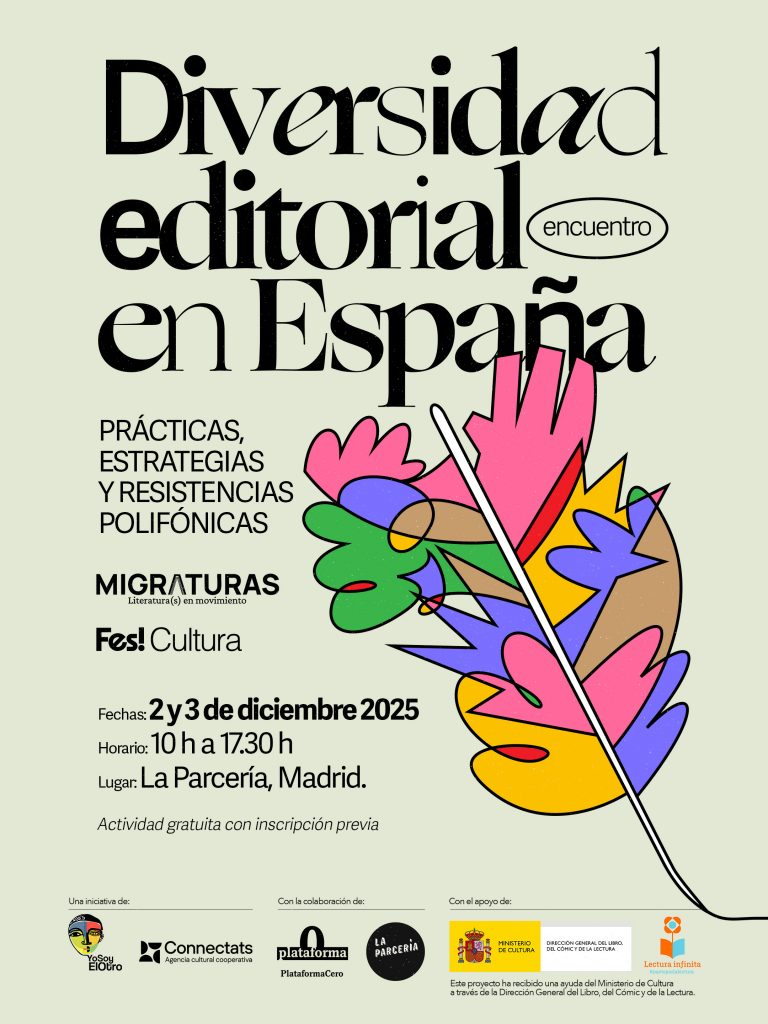
Editorial Diversity in Spain

Polyphonic Strategies and Resistances

[Registration form]

[Full programme]

Diverse publishing in Spain is advancing amid challenges and new initiatives. Projects driven by migrant and racialised people are opening up spaces, questioning traditional ways of writing, publishing, and circulating stories, and proposing other possible approaches within the publishing ecosystem.

To contribute to this movement, Migraturas & Fes! Cultura, in collaboration with La Parcería & Plataforma Cero, are convening the Encuentro: Diversidad editorial en España, a space for dialogue, learning, and collective reflection aimed at recognising ourselves as a sector, exchanging professional tools, and strengthening networks among book practitioners.

Over two days, we will bring together writers, editors, independent projects, collectives, and other initiatives connected to the world of books to share experiences, activate collaboration networks, and open conversations around the challenges, tensions, and possibilities shaping diverse publishing in Spain.

Programme of the gathering

Day 1 – December 2

Ist Migraturas Gathering

A day dedicated to making visible and strengthening editorial creation driven by migrant and racialised people in Spain.

Through conversations with authors, editors, and independent projects, we will explore current practices, strategies, and forms of resistance within the publishing ecosystem.

It will also be a space to connect initiatives, discover new voices, and build professional relationships.

Day 2 – December 3

Editorial Knowledge Lab – Fes! Cultura

A practical and training-oriented day focused on professional exchange. Throughout the day, participants will share concrete tools, working methodologies, and experiences that strengthen independent and diverse publishing. Designed both for established projects and for those just starting out.

Knowledge Routes

A dynamic format in which participants will move through different labs guided by specialists in:

  • Distribution
  • Catalogue development
  • Sustainability
  • Communication

Each session proposes a practical exchange based on real experiences, offering professional resources and opportunities for collaboration.

Challenges and futures of diverse publishing

To close the day, a participatory space will be opened to share conclusions and visions for the future. We will identify common challenges and possible actions to strengthen and expand the presence of migrant and diverse voices in the Spanish publishing ecosystem. A collective exercise combining reflection, applied tools, and network-building.

An initiative by: Yo soy el Otrx & Connectats
With the support of: La Dirección General del Libro, del Cómic & de la Lectura, del Ministerio de Cultura
In collaboration with: La Parcería, La Parcería Edita & Plataforma Cero
Dates: December 2-3, 2025
Schedule: 10:00 -17:30 h
Location: La Parcería, Madrid
Free activity with prior registration

Escena Migrant

Training sessions in performing arts for artists from diverse backgrounds

PROGRAMME [ES]

PROGRAMME [CAT]

Fes! Cultura launches Escena Migrant, a programme of support and training aimed at artists from diverse backgrounds who are already working in the field of performing arts. The project offers practical workshops focused on four key areas: communication of performing arts projects, the use of technologies for contemporary creation, funding, and strategies for circulation within and beyond Catalonia.

The sessions combine technical learning with opportunities to meet recognised professionals from the theatre sector, fostering dialogue, collaboration, and the exchange of experiences. Through these sessions, participants will be able to strengthen their creative capacities, expand their networks, and access new resources to advance their artistic careers.

Escena Migrant aims to contribute to a more plural and representative performing arts ecosystem, where cultural diversity is a central value rather than an exception. The goal is to strengthen artists’ skills, improve the visibility of their projects, and facilitate their access to existing programming and production circuits.

Programme

  • Monday, November 24 · Nau Ivanow: Co-working space

Communication and dissemination of performing arts projects

10:30 – 13:30 

Session 1: Communication strategies for performing arts projects

(Diego Salazar, Col·lectiu Enjambre & Marta Oliveres)

13:30 – 15:00: Shared meal (terrace)

15:00 – 18:00 

Session 2: The artistic dossier and sales dossier for a performance

(Mila Rodriguez)

  • Wednesday, November 26 · Nau Ivanow: Theatre

Technologies and creation

10:30 – 13:30 

Session 3: Designing interactive experiences

(Xesca Salvà Cerdà & Marc Villanueva)

13:30 – 15:00: Shared meal (terrace)

15:00 – 18:00

Session 4: Designing interactive experiences (practical workshop)

(Xesca Salvà Cerdà & Marc Villanueva)

  • Thursday, November 27 · Nau Ivanow: Theatre

Funding, circulation, and access to performing arts circuits

10:30 – 13:30 

Session 5: Theatre production and funding in the performing arts

(Marta Riera Pi)

13:30 – 15:00: Comida de traje (terrassa) 

15:00 – 18:00 

Session 6: Markets and strategies to distribute our performance

(Alba Espinasa Galitó)


Escena Migrant is an initiative by Connectats Cooperativa in collaboration with Nau Ivanow and with the support of the Department of Culture of the Government of Catalonia.

Fes! Cultura is a programme by Connectats Cooperativa in collaboration with Fabra i Coats: Creation Factory, with the support of Barcelona City Council, the Department of Culture of the Government of Catalonia, the Spanish Ministry of Culture, and ”la Caixa” Foundation.

(NO) ES FICCIÓN: laboratorio de teatro documental y autobiografía

Teatre documental

Registration Form

Introduction

This workshop proposes a creative journey in which personal experience becomes scenic material. Throughout three intensive sessions, we will explore how to transform archives, documents, and biographies into theatrical narratives with documentary and emotional strength.

Led by Chilean director Ítalo Gallardo, participants will discover references from contemporary theatre, share materials from their own personal archives, and collectively experiment with staging practices. The workshop combines theory and practice to uncover new expressive possibilities and to create a first scenic prototype born from the real voices of its participants.

The workshop is aimed at stage creators from diverse backgrounds who wish to deepen autobiographical research, experiment with testimony-based dramaturgy, and engage in a collaborative creative process.

Methodology

  • Session 1 (3 hours)

In this first session, we will explore key theoretical references to understand contemporary documentary theatre practices, including texts such as What Is the Contemporary? by Giorgio Agamben, Theses on Theatre by Alain Badiou, Confession as a Scenic Strategy by Óscar Cornago, and Practices of the Real in Contemporary Performance by José Antonio Sánchez. We will also analyze three creative processes by Chilean director Ítalo Gallardo: Los que vinieron antes (2016), about family memories; Amanecerá con escombros sobre el suelo (2019), presenting testimonies from survivors of the Chilean earthquake; and Aprendan del fuego (2025), a documentary scenic investigation about Carlos Lehman, a Chilean Air Force pilot who infiltrated left-wing circles during the dictatorship, crossing art and political memory. This session will establish the conceptual foundations for the collective creation process.

  • Session 2 (3 hours)

In this session, each participant will bring and present personal materials from their own archive connected to significant life experiences. Through collective listening and dialogue, the group will identify the elements with the greatest dramatic and narrative potential. The session will focus on extracting emotional lines, conflicts, and symbols capable of feeding the dramaturgy. Through this collective perspective, one of the proposed stories will be selected as the basis for the next stage of scenic creation, fostering analytical skills, collaboration, and critical learning among participants.

  • Session 3 (3 hours)

This final session will function as an experimental staging laboratory where selected materials will be put into practice. Participants will take on different roles —such as stagehands, technicians, and performers— in order to experiment with and rehearse different forms of staging. The objective is to create a dynamic space of trial and error that allows participants to discover new expressive, compositional, and interactive possibilities with autobiographical material. Collective creation will stimulate scenic imagination, consolidating a first scenic prototype with documentary and artistic value.

Who is it for

This workshop is intended for stage creators from diverse backgrounds interested in exploring and applying documentary theatre tools, personal research, and autobiography to dramaturgy and performance-making.

Learning Objectives

By the end of the workshop, participants will be able to:

  • Deepen biographical research for scenic creation.
  • Develop dramaturgies based on personal testimonies and archives.
  • Experiment with collaborative staging and performance techniques.
  • Take on multiple creative and technical roles within theatrical processes.

Practical Information

  • Location: Fabra i Coats: Fàbrica de Creació – Rehearsal Room 1, 3rd floor.
  • Dates: Wednesday 22/10, Thursday 23/10, Wednesday 29/10
  • Schedule: 6:00 PM – 9:00 PM
  • Price: Active participants €77
  • Registration: Registration form (includes payment link)
  • Inscripciones: Formulario (Incluye enlace de pago)

Director’s Profile

Italo Gallardo Betancourt
(Santiago, 1984)
Director, performer, playwright, and teacher.

He holds a degree in Arts with a specialization in Theatre Performance from the University of Chile (2010). He has specialized in investigative scenic practices working with archives, documents, and biographies. His works explore the limits of performing arts through different forms of experimentation, including documentary theatre, performative lectures, expanded cinema, and sound walks.

In 2008, he founded the collective La Laura Palmer, through which he developed documentary stage productions over 15 years of activity.

In 2024, he created the collective Pierre Menard, where he currently continues his artistic research.

His work has been presented in Chile, Mexico, Argentina, Colombia, the United States, Spain, Italy, and Brazil.

Among his highlighted projects are:

  • Aprendan del fuego (2025)
  • A este lado del río solo el silencio (Guadalajara, 2020)
  • Animales invisibles (Santiago, 2019)
  • Amanecerá con escombros sobre el suelo (Concepción, 2019)
  • Los que vinieron antes (Santiago, 2016)

As a performer, he participated in “El año en que nací” (2012-2017) by Lola Arias, performing at festivals and events across Europe, Australia, the United States, and Latin America.

He has been invited by Circuito de Centros Cívicos de Barcelona, la Universidad de la Sapienza de Roma, Festival FIBA, Teatro Galpón de Guevara, Goethe Institut México, Teatro Casa del Lago UNAM, Festival de Manizales, Centro Cultural de Guanajuato, Fundación Siemens-Stiftung, New York Theatre Workshop, Fira Tárrega, SESC São Paulo, Centro Cultural Británico de Lima, Festival Internacional Santiago a Mil, Festival Santiago Off, Paisaje Público, Festival Cielos del Infinito, Festival Temporales Teatrales, Festival Lluvia de Teatro, Teatro Nacional Chileno, Teatro Bío-Bío, Centro Cultural GAM, Teatro ICTUS, Centro de Creación NAVE, Teatro La Memoria, Matucana 100, Teatro Camilo Henríquez, Universidad Finis Terrae, Universidad Mayor, Universidad de Chile y Centro Cultural Estación Mapocho, among others, as a resident artist and teacher. In these spaces, he has developed research projects, stage productions, and workshops focused on documentary and biographical theatre.

About Fes! Cultura

Fes! Cultura is a cultural project incubator that trains, supports, and promotes cultural creators from diverse backgrounds in Barcelona. Its work focuses on collaborative learning and the development of innovative cultural proposals, especially projects defending cultural rights, migratory justice, and ecosocial sustainability. Its programs include #AccióMigrant, supporting migrant artists, and #AccióClima, promoting culture for environmental action. Fes! Cultura also organizes events, workshops, and meeting spaces to strengthen cultural networks with social impact, fostering the professionalization and visibility of creators committed to social change.

Credits

Fes! Cultura is a program by Connectats Cooperativa in collaboration with Fabra i Coats: Fàbrica de Creació. The program is supported by Fundación “la Caixa”, Ajuntament de Barcelona, and the Department of Culture of the Government of Catalonia.

2025 Laboratory

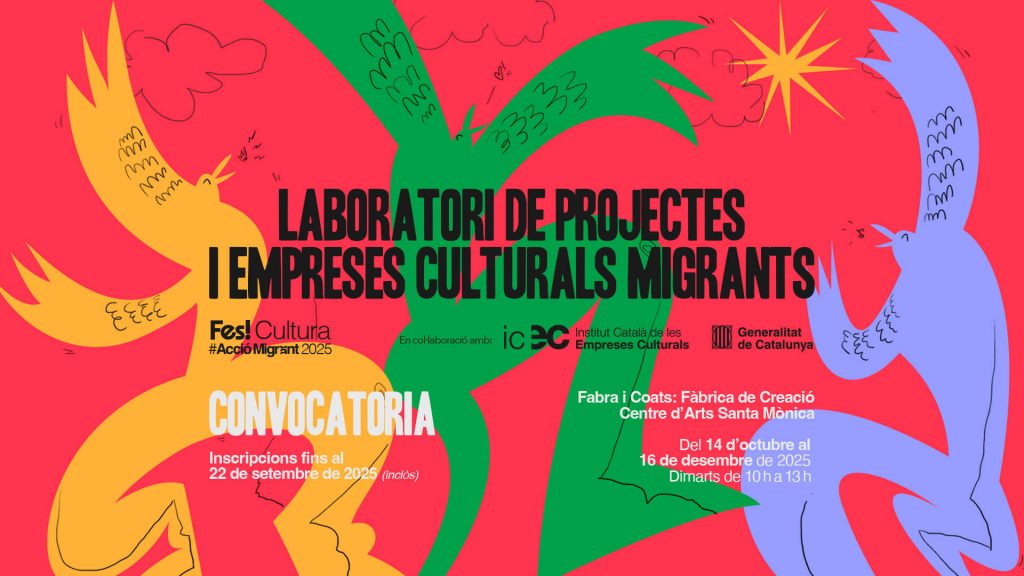
Laboratori de projectes i empreses culturals migrants

What is Fes! Cultura?

Fes! Cultura is an incubator for cultural projects with social impact that promotes the participation of diverse individuals and communities in the creation of transformative cultural initiatives. It explores collaborative forms of learning and production involving artists, cultural managers, and other professionals from the sector in the development of sustainable cultural projects.

Cultural Projects and Enterprises Lab

This year we are presenting a modular training programme aimed at empowering artists and cultural agents from diverse backgrounds, with the goal of strengthening their professional skills, facilitating their integration into the local cultural ecosystem, and promoting sustainable models of cultural development. The programme offers practical tools to design, finance, and manage cultural projects with impact. The training combines cultural rights approaches with strategies for economic sustainability, visibility, and professionalization, in order to strengthen the role of migrant and racialized cultural agents as key actors within the Catalan cultural landscape.

Who is it for?

Fes! Cultura #AccióMigrant is aimed at artists and cultural management professionals from diverse backgrounds who reside in Catalonia and are developing an initiative in the fields of arts, creation, or culture. Priority will be given to proposals with growth potential linked to performing arts, visual arts, music, audiovisual media, literature, or digital culture.

¿Cómo lo hacemos?

  • Total duration: 10 sessions / 30 hours
  • Dates: from October 14 to December 16, 2025
  • Schedule: Tuesdays from 10:00 a.m. to 1:00 p.m.
  • Locations: Centre d’Arts Santa Mònica and Fabra i Coats: Fàbrica de Creació
  • Frequency: 1 weekly session of 3 hours
  • Format: in person
  • Methodology: lectures combined with practical and participatory exercises

Programme

  • Session 1. Introduction and Mapping of the Cultural Ecosystem

Welcome session, presentation of the programme, and introduction to people-centred cultural economies. Mapping of the cultural context in Barcelona and Catalonia.

  • Session 2. Designing Cultural Projects with Impact (Part 1)

Introduction to the basic skills needed to conceptualize a cultural project with impact. We will work on diagnosis, strategic approach, and alignment with cultural rights in order to structure viable and relevant proposals.

  • Session 3. Designing Cultural Projects with Impact (Part 2)

We will deepen the technical structuring of the project: formulation of objectives, activity planning, resource allocation, scheduling, and the design of evaluation and sustainability strategies.

  • Session 4. Public Funding and Cultural Calls

Overview of grants and public funding opportunities at local, regional, and national levels. Practical analysis of real calls and evaluation criteria.

  • Session 5. Direct Funding and Sustainable Income Models

We will explore self-financing strategies: ticket sales, services, collaborations, patronage, and digital monetization. We will design hybrid models.

  • Session 6. Legal Structures and Organizational Models

Comparative presentation of legal structures: self-employed status, associations, cooperatives, and limited companies. Practical cases and legal support resources.

  • Session 7. Taxation and Invoicing for Cultural Agents

Practical guide to legal invoicing and managing basic taxes (VAT, income tax). Introduction to labour rights and the Artist’s Statute framework.

  • Session 8. Communication for Cultural Projects

We will discover how communication, approached strategically, can become an ally in growing your project and community.

  • Session 9. Evaluation and Sustainability of Cultural Projects

We will define indicators and methodologies to measure impact. Reflection on partnerships, care practices, and medium-term continuity strategies.

  • Session 10. Closing Session and Project Presentations

A space to share projects, engage in collective recognition, and envision future pathways. Certificate ceremony and final celebration.

Practical Information

When and where

From October 14 to December 16, 2025.

Tuesdays from 10:00 a.m. to 1:00 p.m.

Fàbrica de Creació Fabra i Coats. c/ Sant Adrià, 20. Barcelona.

<M> Sant Andreu

Centre d’Arts Santa Mònica. La Rambla, 7. Barcelona.

<M> Drassanes

Contact:

Email: hola@fescultura.org

Instagram: @fes_cultura

Web: fescultura.org

Credits

Fes! Cultura is an initiative by Connectats Cooperativa, in collaboration with the University of Barcelona Master’s Degree in Cultural Management, Fabra i Coats: Fàbrica de Creació and Centre d’Arts Santa Mònica.

With the support of the Institut Català de les Empreses Culturals, the Ajuntament de Barcelona, and the Fundació ”la Caixa”.

PDF Dossier

Fes! Cultura/ Fem Circuits

Challenges and opportunities of artistic creation, programming, and exhibition circuits in Barcelona from an anti-racist and intercultural perspective.

Presentation

The “Fes! Cultura / Fem Circuits” conference is a collaborative working space aimed at analysing the challenges and opportunities of artistic programming and exhibition circuits in Barcelona from an anti-racist and intercultural perspective. Its objective is to generate knowledge and tools that foster a more diverse, accessible, and innovative Catalan cultural ecosystem, responding to the urgent need for cultural institutions and venues to reflect the plurality of origins and expressions present in the city.

Throughout the conference, both the challenges of access to programming circuits and the barriers within creation, production, and distribution processes will be addressed, understanding that exhibition is only the final step of an interdependent chain. Issues such as the precarization of cultural work will be analysed, as well as new forms of recognition and fair conditions for migrant and racialized artists. Through working groups, participants will imagine a possible future horizon and design actions to move towards this desired scenario.

The meeting will bring together cultural agents, artists, managers, and organizations from the fields of music, performing arts, visual arts, and audiovisual media, with the aim of sharing best practices, identifying obstacles, and proposing concrete actions to advance towards fairer and more representative cultural circuits.

Programme

09:45 – 10:15 | Welcome and introduction
Reception of participants and general framework of the conference: objectives, dynamics, and context of the activity within the framework of Fes Cultura! 2025.

10:15 – 11:00 | Presentation of best practices in cultural circuits
Short presentations by leading institutions and organizations. Centre d’Arts Santa Mònica, Barcelona Districte Cultural, Dones Visuals, Sala Paral·lel 62.
Each organization explains its approach, actions, and challenges in incorporating diversity into programming.

11:00 – 12:15 | Sector-based working groups
Division into 4 groups: Music, Performing Arts, Visual Arts, Audiovisual.

  • Definition of a long-term objective. (Future horizon)
  • Participatory diagnosis of barriers to professional circuits for migrant and racialized artists. (Starting point)
  • Key proposals to move towards a more representative sector. (Actions now)

12:15 – 12:40 | Coffee break and networking

  • Space for refreshments.
  • Open exchange to connect participants and organizations.
  • Table with information on reference initiatives. (Mapping)

12:40 – 13:20 | Dynamic plenary and collective feedback
Agile and creative presentation of each group’s results.

  • Collective visualization of barriers, objectives, and proposals in a shared mural or map.
  • Space to identify synergies and priorities for action.

13:20 – 13:30 | Closing and next steps
Final summary, acknowledgements, and reminder regarding the systematization and dissemination of results.

Facilitated by

Diego Salazar (Coordination and moderation)
Cultural manager and researcher. Co-founder and director of Connectats Cooperativa, an agency specialized in the design and implementation of cultural programmes with social impact. Promoter of Fes! Cultura, a project incubator that fosters ecosocial transformation and the active participation of migrant and/or racialized people within the Spanish cultural ecosystem. He has led more than 25 initiatives in the fields of diversity, memory, education, and citizen participation, strengthening the local cultural fabric and promoting the exercise of cultural rights without discrimination. Holds a degree in Audiovisual Communication from the Universitat Pompeu Fabra and a master’s degree in Cultural Management from the Universitat de Barcelona.

Salima Jirari (Audiovisual)
Development content consultant specialized in diversity representation and researcher in the film industry. With fifteen years of experience in the audiovisual sector, she has worked with institutions and organizations such as Selecta Visión, DocsBarcelona, the Ministerio de Cultura, the Academia de Cine, Netflix, DAMA, Proimágenes Colombia, and Coofilm, as well as several universities. PEI MACBA Alumni, she currently also coordinates the Diversity, Equality, and Inclusion area at Dones Visuals.

Natalia Carminati (Visual Arts)
Visual artist and researcher specialized in the critical analysis of contemporary culture, postcolonial theory, biotechnology, and food sovereignty. Her work focuses on the creation of multisensory devices combining video games, installation, painting, audiovisual languages, living organisms, gastronomy, and performance. She has exhibited in institutions such as the MACBA, the Museu Picasso Barcelona, the Centre d’Arts Santa Mònica, and international venues such as Linden New Art and Kunstmuseum Stuttgart. Awarded grants and prizes by the Generalitat de Catalunya, Barcelona City Council, and Baden-Württemberg, she has been a board member of the PAAC since 2022.

Óscar Arboleda (Music)
Cultural manager and researcher, PhD candidate in Philosophy and holder of a master’s degree in Contemporary Thought from the Universitat de Barcelona, with a background in Literature and Music in Colombia. He has developed his career in media and institutions such as RCN, Canal Caracol, El Espectador, Sony Entertainment Television, the Superintendencia de Industria y Comercio, and the Ministerio de Cultura de Colombia. He has promoted social projects such as Escola Nodal and is the composer of “Lejanías”, as well as co-founder and co-director of the LATIR Festival, Latin American Cultural Week.

Adriana Fuertes Lara (Performing Arts)
Afrofeminist creator with a background in Social and Cultural Anthropology (UAB) and Communication (UPF), and an artistic career initiated at the Col·legi del Teatre de Barcelona. Member of the Tinta Negra collective, she focuses her practice on the visibility and inclusion of Afro-descendant women creators. As a screenwriter, she has been a resident at the Acadèmia de Cinema Català with the project “Beba” and selected for Òpera Prima ESCAC 2024. Her short film “Heartbeat, Soul and Machete” has been recognized in several festivals and residencies. As an actress, she stands out in productions such as “Fam”, “Assaig sobre la ceguesa”, “Running for Democracy”, and “What The Foc!”, produced by the TNC and the Royal Flemish Theater.

Gigi Ríos (Production and Reporting)
Cultural and editorial project manager with more than 15 years of experience leading initiatives that combine culture, education, and social transformation in Bogotá and Barcelona. She has worked at Connectats Cooperativa, developing impactful cultural and educational programmes, and is the founder of Hoja Rota, an editorial solutions platform. Her career includes strategic project management, educational methodology design, cultural event production, and social innovation consultancy. As an editor and narrative advisor, she supports authors and collectives in the creation, editing, and publication of content with depth and transformative potential. A strong advocate for the value of culture and education, she works from an ethical, aesthetic, and political perspective on the written word.

Lina Ruiz (Reporting)
Colombian cultural manager with a degree in Arts and Philosophy from the Universidad de los Andes and a master’s degree in Global Markets, Local Creativities from the universities of Glasgow, Barcelona, and Rotterdam. Since 2011, she has worked in the cultural sector in coordination, programming, curating, and production roles, specializing in multidisciplinary platforms and the creation of new knowledge-production formats. Since 2022, she has been based in Barcelona, linked to Trànsit Projectes, where she formulates, designs, and coordinates education and culture projects at local and European levels. Founder of the Micelio Cultural project (@miceliocultural), situated at the intersection of art, food culture, planetary ecologies, and journalism. She is part of the culinary and artistic collectives @las.jamaiconas and @labarrejada, and social and solidarity economy projects such as Las Espigadoras, Biblioteca de les coses in Poble Sec, and La Igualitària.

Co-organized by: Espai Avinyó

Fes! Cultura is a programme promoted by Cooperativa Connectats with partial support from the Ajuntament de Barcelona, the Departament de Cultura de la Generalitat de Catalunya, and the Fundació ”la Caixa”.