A modular online training programme aimed at equipping artists and cultural practitioners from diverse backgrounds with the skills to strengthen their professional competences.
Continue reading

A modular online training programme aimed at equipping artists and cultural practitioners from diverse backgrounds with the skills to strengthen their professional competences.
Continue reading
Talking about cultural rights means going beyond access to goods, services, venues, or programmes. Being able to attend a concert, visit a museum, or use a library is part of those rights, but it does not exhaust them. Culture is not simply something that some people produce and others receive. It is also a space where we build narratives, express identities, share knowledge, establish relationships, and take part in collective life.
Exercising cultural rights therefore means having real opportunities to create, express oneself, produce, organise, cooperate, and participate. It means recognising people not only as audiences for a cultural offer, but also as agents capable of launching initiatives, creating spaces, developing projects, and taking part in decisions that shape the cultural life of their territories.
The right to culture move beyond being understood solely as the right to access what others produce and become, as well, the effective possibility of creating, organising, and participating in the construction of cultural life.
This distinction matters. A society may have a rich cultural programme, good facilities, and high levels of cultural consumption while still offering few opportunities for someone to turn an idea into a project, find a space in which to develop it, organise with others, or access the resources needed to sustain it. Guaranteeing access is essential. But cultural democracy also requires us to expand people’s capacity to make culture.
Strengthening the cultural fabric is precisely about that capacity for action. It requires resources and funding that make it possible to develop projects, pay for work, and sustain processes over time. It also requires creating better conditions for people, collectives, and organisations to develop their own initiatives, make decisions with greater autonomy, build relationships, and give continuity to their work.
The capacity to act depends on many factors. It depends on available knowledge, on tools for designing and managing a project, on access to funding and spaces, on the strength of teams, and on relationships that make it possible to find collaborators, learning opportunities, and new possibilities. It also depends on the context in which these initiatives operate. A project may be well designed and supported by a capable team, yet still face major difficulties if there are no accessible spaces, if funding is unstable, or if cultural policies fail to recognise certain forms of organisation and participation.
That is why strengthening the cultural fabric means working simultaneously on the capacities of those who make culture and on the conditions that allow those capacities to develop. It means expanding the autonomy of cultural actors, facilitating the circulation of knowledge and resources, improving opportunities for cooperation and access, and creating environments in which a greater diversity of initiatives can emerge, grow, and be sustained over time.
This perspective leads us to a question we at Fes! Cultura have been asking ourselves for some time. Where can we act to strengthen the cultural fabric? If the cultural capacity of a territory depends on multiple factors, it seems clear that we need to work at more than one scale.
The first is projects. Many initiatives begin with an idea, an artistic practice, or a need identified in a particular territory. Turning them into viable projects requires knowledge, tools, support, resources, networks, and opportunities. Strengthening this scale means increasing the capacity of people and collectives to make decisions, plan, organise, and build sustainable proposals.
The second is organisations. Projects need structures that allow them to continue over time. Associations, cooperatives, foundations, cultural enterprises, and other teams accumulate knowledge, sustain relationships, and make it possible for an initiative not to depend permanently on the efforts of just a few people. Working on their strategy, organisation, governance, sustainability, and alliances helps consolidate this collective capacity.
The third is ecosystems. Even strong projects and solid organisations encounter limits when the environment in which they operate makes development difficult. Public administrations, institutions, cultural venues, and networks have the capacity to change those conditions through policies, programmes, funding, access to spaces, participation mechanisms, network activation, and forms of recognition that are more open to existing cultural diversity.
Strengthening the cultural fabric requires connecting these three scales. Increasing the capacity of those who lead projects, consolidating the organisations that sustain them, and improving the conditions in which they operate. Only then can the right to culture move beyond being understood solely as the right to access what others produce and become, as well, the effective possibility of creating, organising, and participating in the construction of cultural life.
By: Diego Salazar
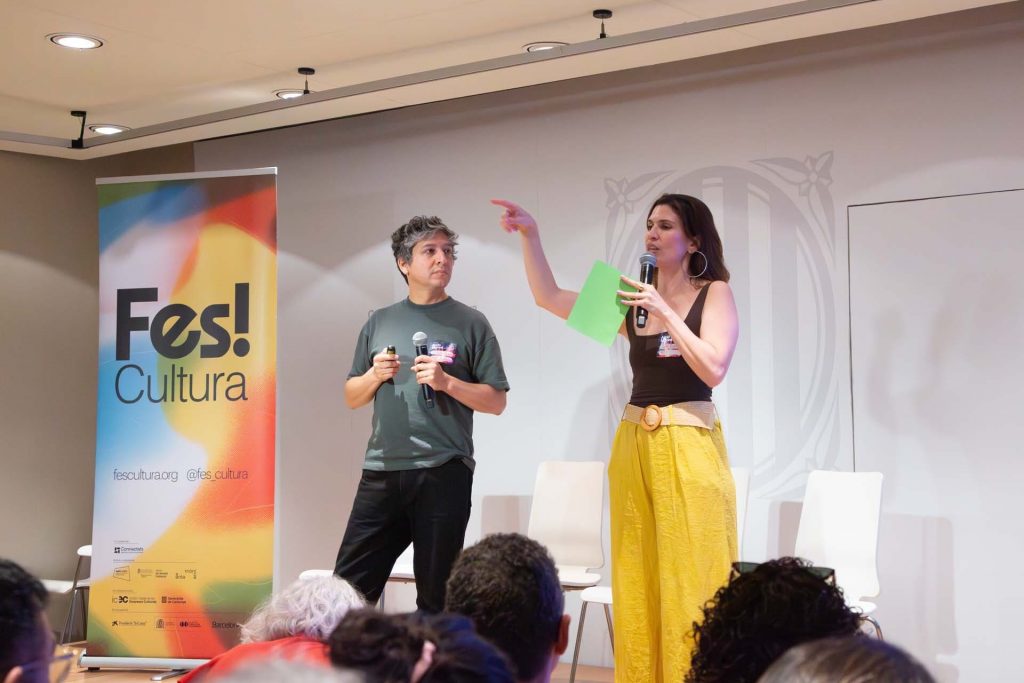
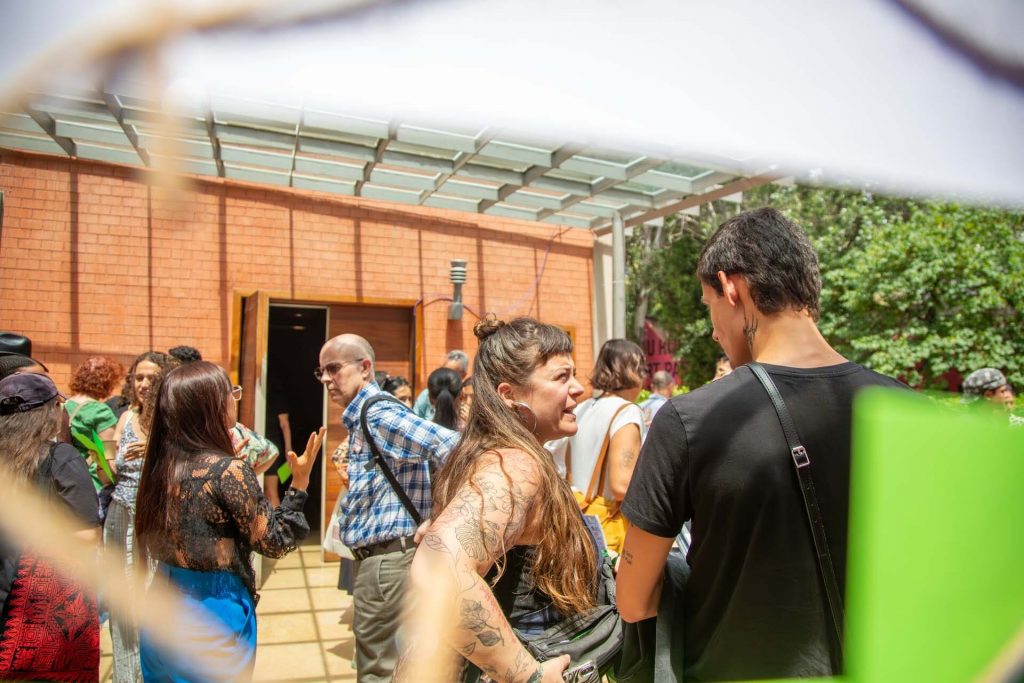
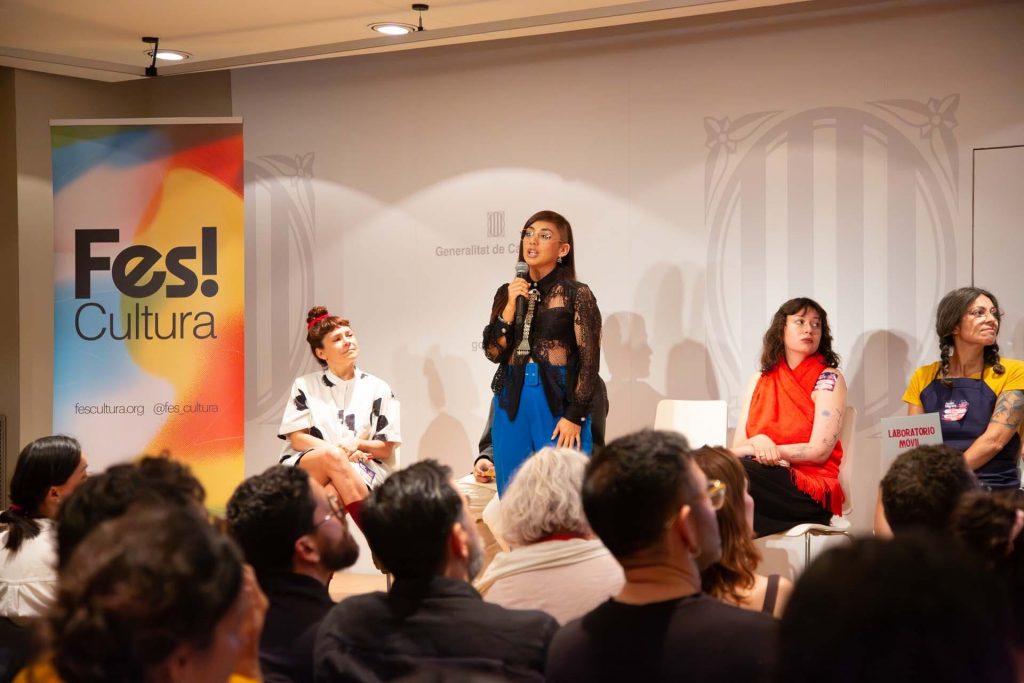

A two-day gathering aimed at recognising, connecting and strengthening Pamplona’s migrant and racialised cultural fabric, creating spaces for reflection, exchange and collective action.
Continue reading
When migrants don’t build their own narratives, others build them for them. Mafe Carrascal, Representative to the Colombian Chamber, talks about culture, diaspora and political power in a new episode of Fes! Cultura Podcast recorded live in Barcelona.
Continue reading
En el marco del Festival La Kumbiamba, este episodio de Fes! Cultura Podcast explora cómo proyectos como Las Forasteritas, Marina y su Melao y Meli Perea reconfiguran sonidos ancestrales —huayno andino, bomba puertorriqueña y ritmos afrocaribeños— en el contexto urbano de Barcelona.
Continue reading
On 9 June, #AccióMigrant – Project Activation Gathering will bring together participants to share the 26 initiatives developed over recent months.
Continue reading
The FIL_IN showcase opens from March 5 to April 18 at Fabra i Coats: Creation Factory, a cycle that brings to the stage the creative processes of the space’s resident musical projects. In total, 21 acts will share their work with the public in a concert format that echoes the venue’s past as a former textile factory.
Over several weeks, the multipurpose halls of Fabra will be filled with music, presenting projects that are currently taking shape in a living moment of their creative process.
Within this framework, Fes! Cultura (Connectats Cooperativa) – a cultural incubator supporting projects led by migrant artists and a resident project at Fabra i Coats – joins the programme on Saturday, April 11 at 7:00 pm with a session featuring three powerful and diverse musical proposals.
Tina Masawi
The afternoon will begin with Tina Masawi, a Zimbabwean-born singer presenting her debut album with a powerful and elegant afro-soul sound.
Her music blends pop, R&B, blues, and afrobeat, creating a sound that connects with her roots while showcasing great stage versatility. Her work has already resonated at festivals such as Cruïlla and Jazztrònica, establishing her as one of the most exciting emerging voices in Barcelona’s music scene.
Cecé & The Soul Kitchen
From Venezuela comes Cecé & The Soul Kitchen, a project that explores an urban universe where soul, jazz, hip-hop, and R&B coexist with Caribbean rhythms.
Led by artist and producer Cecé, the group builds bridges between the Latin American diaspora and Barcelona’s contemporary music scene, in a proposal where tradition and urban spirit naturally come together.
La Ruka
The evening will culminate with La Ruka, an explosive proposal that blends hip-hop, dancehall, electronic music, salsa, and sounds from the Colombian Pacific.
Based in Barcelona, the artist explores cultural resistance through direct lyrics and a powerful sonic energy that celebrates identity, memory, and Afro-descendant roots.
This collaboration between Fabra i Coats: Creation Factory and Fes! Cultura stems from the desire to expand the city’s cultural circuits and open space for musical proposals led by migrant and racialised artists living and creating in Barcelona.
Fes! Cultura, a programme promoted by Connectats Cooperativa, supports cultural projects by artists from diverse backgrounds and facilitates their development within the cultural ecosystem of Catalonia and Spain.
Listen to the FIL_IN mixtape
Practical information
Date: 11 d’abril de 2026
Time: 19.00 h
Location: Fabra i Coats: Fàbrica de Creació
Carrer de Sant Adrià, 20 · Barcelona
Free entry
Graphic design: La Murga Lab

Fes! Cultura Podcast with María José Pizarro
REGISTRATION CLOSED (full capacity)
🌟 Reminder for registered attendees: As capacity is limited, entry will be granted on a first-come, first-served basis until the venue is full. We recommend arriving early to secure your spot. You can also follow the event via Instagram Live:https://www.instagram.com/fes_cultura/
In 2009, during her exile in Barcelona, María José Pizarro developed the exhibition “I’ll Be Back. Carlos Pizarro, Memory for Peace”, presented at Casa Amèrica Catalunya. For her, this project marked a reunion with her father after 18 years of absence: an exercise in memory, repair, and dialogue that signalled her debut as a curator and cultural manager in the diaspora.
Years later, she starred in and co-produced the documentary “Pizarro” (2015, dir. Simón Hernández), which reconstructs her father’s life from an intimate perspective: a personal journey to reconcile with his legacy, understand the causes of his assassination in 1990, and recover a chapter silenced by violence and fear.
These two experiences, developed in Barcelona’s Poble-sec neighbourhood, had a strong impact in Colombia, leading María José to join the Bogotá Department of Culture, the National Centre for Historical Memory, and to begin a political career as a Member of the House of Representatives and later as a Senator, a position she currently holds.
In this conversation, we will explore how these cultural projects were developed and the meaning they have had both in her life and in Colombia’s recent history: the right to one’s own narrative, the power of art to transform the personal into the collective, and memory as a tool for repair. We will also reflect on the role of migrant cultural agents: a Colombia that exists beyond its borders but continues to act as a force for change.
The Fes! Cultura podcast is a space for conversation and reflection where artists, creators, and cultural agents share how their creative practices generate transformation in their lives, communities, and territories. From a diverse and committed perspective, the podcast highlights experiences that connect art and social change, showing how culture can be a tool to imagine and build more just, sustainable, and plural futures.
In collaboration with Fabra i Coats: Fàbrica de Creació y Sala Oasys Barcelona.
Cover photo: Gustavo Aguado

By Diego Salazar
Perhaps the greatest challenge of the present is to understand that the struggle for cultural rights is also a struggle for the right to life. Because those who are left out of the narrative are also left out of protection.
When violence becomes routine, it ceases to provoke scandal and begins to be called normality. December has been proof of this. In just a few weeks, a succession of political decisions and public scenes has laid bare, without disguise, how the European social contract is being redefined along racial lines, also in Catalonia and Spain.
At the beginning of the month, the Council of the European Union approved decrees that facilitate mass deportations and consolidate the externalisation of borders, violating fundamental rights and international law itself. Days later, during an event organised by the Government of Catalonia —paradoxically— dedicated to the International Day of Migrants, two anti-racist activists were expelled for denouncing the eviction of the B9 Institute in Badalona, which was carried out the following day: more than 400 migrant people were left on the street, exposed to the winter cold. Shortly after, a group of neighbours blocked access to a church to prevent temporary shelter for fifteen of them. That same week, the closure of Periferia Cimarronas, was also announced, the first Black theatre in Spain, an Afro-centred project that has built community and critical thought from the margins of an institutional framework that never fully embraced it.
It may seem like a concatenation of isolated events. In reality, it is the expression of a structural problem. Migration policies, the cultural system, and the national imaginary converge in the same architecture of exclusion: one that administers material and symbolic dispossession as routine, that expels bodies and erases voices, that legislates inequality while proclaiming universal rights.
The closure of Periferia Cimarronas is also a symptom of the political hollowing-out of the Catalan and Spanish cultural system, which for years has promoted diversity as an aesthetic without assuming it as a structure.
The timing is particularly revealing. That all of this happens in the days leading up to Christmas, the great celebration of peace and fraternity in the Christian calendar, is not only a cruel irony. It exposes how the language of rights has become a rhetorical device that conceals the hypocrisy of the public apparatus. Europe celebrates the birth of a refugee child while criminalising those who flee wars that it itself fuels; Catalonia celebrates “the day of migrants” while repressing and evicting racialised bodies from their living spaces; the Church preaches welcome while part of its congregation raises walls in the name of fear and identity purity.
What unfolds is not a sum of incidents, but a necropolitics: the capacity of the State and society to decide who lives and who dies, who deserves shelter and who can be cast into exposure. This logic is not exercised only through laws or police forces. It is also sustained by a more subtle machinery: that of normalised institutional racism, which distributes humanity along hierarchical scales and reserves compassion for some while administering suspicion toward others.
The eviction of the B9 Institute in Badalona shows the most atrocious face of this order. There, exclusion materialises in stone and concrete: racialised bodies treated as urban waste, municipal policies that turn hardship into a disciplinary spectacle, media discourses that rewrite the victim as a threat. In contrast, the closure of Periferia Cimarronas reveals the other face of the same device: symbolic eradication, the silencing of voices that speak from Blackness, migration, and dissent.
Both forms operate across different frontiers —the urban and the cultural— but respond to the same principle: the country that expels bodies is the same one that shuts down imaginaries. Where precarity takes away housing, racism takes away voice. One denies shelter; the other denies the possibility of narrating oneself, of being seen, of existing in the shared space. They are two complementary ways of restricting citizenship and sustaining the fiction of a homogeneous, white, and morally intact nation.
The closure of Periferia Cimarronas is also a symptom of the political hollowing-out of the Catalan and Spanish cultural system, which for years has promoted diversity as an aesthetic without assuming it as a structure. The few spaces sustained by racialised and migrant communities survive with scarce public support, trapped in the precarity that the same “inclusive” policies claim to combat. When an Afro-centred theatre disappears, it is not only a cultural loss: it is the symbolic expression of the same violence that leaves hundreds of people without a home.
However, migrant and racialised cultural production continues to be a luminous crack in that wall. It is not only aesthetic resistance, but a politics of the living: a practice of reappropriating space, of rewriting memory, of expanding what is possible.
Racism in Spain no longer needs to declare itself. It filters into everyday life, into administrative gestures, into selective compassion. It speaks of integration while legislating deportations; it speaks of interculturality while dismantling spaces of autonomy. It is sustained, above all, by indifference: by the moral fatigue of a society that, saturated with images of pain, has confused empathy with spectacle.
However, migrant and racialised cultural production continues to be a luminous crack in that wall. It is not only aesthetic resistance, but a politics of the living: a practice of reappropriating space, of rewriting memory, of expanding what is possible. This culture does not ask for inclusion: it exercises political imagination.
Perhaps the greatest challenge of the present is to understand that the struggle for cultural rights is also a struggle for the right to life. Because those who are left out of the narrative are also left out of protection. And because a country that expels the most vulnerable from the territory and the most uncomfortable from discourse cannot call itself democratic.
In this Christmas of 2025, while Europe projects borders overseas and Spain warns about “extremisms” and “disinformation”, it is important not to lose sight of what is essential: the real crisis is not migratory, it is the renunciation of the welfare state to guarantee universal rights, first for migrant people and then for society as a whole.
And what may open a way out will not be the charity of the centre, but the imagination of the margins. That place from which we still rehearse —against the current— the radical art of caring for each other in community.

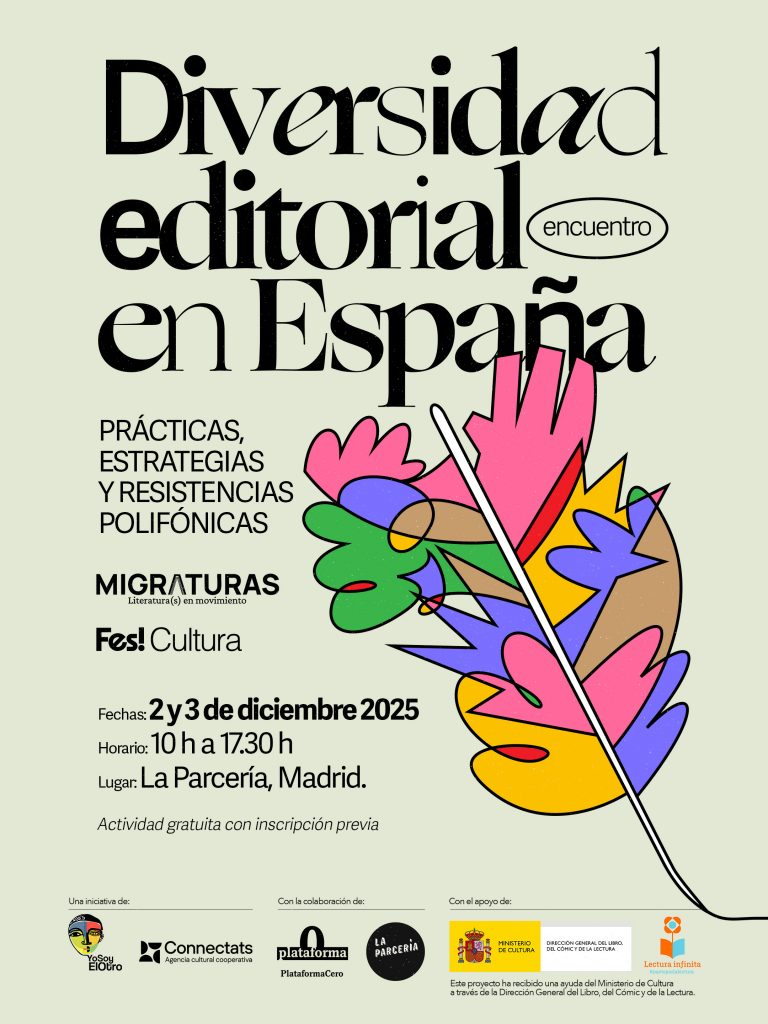
Polyphonic Strategies and Resistances
Diverse publishing in Spain is advancing amid challenges and new initiatives. Projects driven by migrant and racialised people are opening up spaces, questioning traditional ways of writing, publishing, and circulating stories, and proposing other possible approaches within the publishing ecosystem.
To contribute to this movement, Migraturas & Fes! Cultura, in collaboration with La Parcería & Plataforma Cero, are convening the Encuentro: Diversidad editorial en España, a space for dialogue, learning, and collective reflection aimed at recognising ourselves as a sector, exchanging professional tools, and strengthening networks among book practitioners.
Over two days, we will bring together writers, editors, independent projects, collectives, and other initiatives connected to the world of books to share experiences, activate collaboration networks, and open conversations around the challenges, tensions, and possibilities shaping diverse publishing in Spain.
Day 1 – December 2
Ist Migraturas Gathering
A day dedicated to making visible and strengthening editorial creation driven by migrant and racialised people in Spain.
Through conversations with authors, editors, and independent projects, we will explore current practices, strategies, and forms of resistance within the publishing ecosystem.
It will also be a space to connect initiatives, discover new voices, and build professional relationships.
Day 2 – December 3
Editorial Knowledge Lab – Fes! Cultura
A practical and training-oriented day focused on professional exchange. Throughout the day, participants will share concrete tools, working methodologies, and experiences that strengthen independent and diverse publishing. Designed both for established projects and for those just starting out.
Knowledge Routes
A dynamic format in which participants will move through different labs guided by specialists in:
Each session proposes a practical exchange based on real experiences, offering professional resources and opportunities for collaboration.
Challenges and futures of diverse publishing
To close the day, a participatory space will be opened to share conclusions and visions for the future. We will identify common challenges and possible actions to strengthen and expand the presence of migrant and diverse voices in the Spanish publishing ecosystem. A collective exercise combining reflection, applied tools, and network-building.
An initiative by: Yo soy el Otrx & Connectats
With the support of: La Dirección General del Libro, del Cómic & de la Lectura, del Ministerio de Cultura
In collaboration with: La Parcería, La Parcería Edita & Plataforma Cero
Dates: December 2-3, 2025
Schedule: 10:00 -17:30 h
Location: La Parcería, Madrid
Free activity with prior registration